










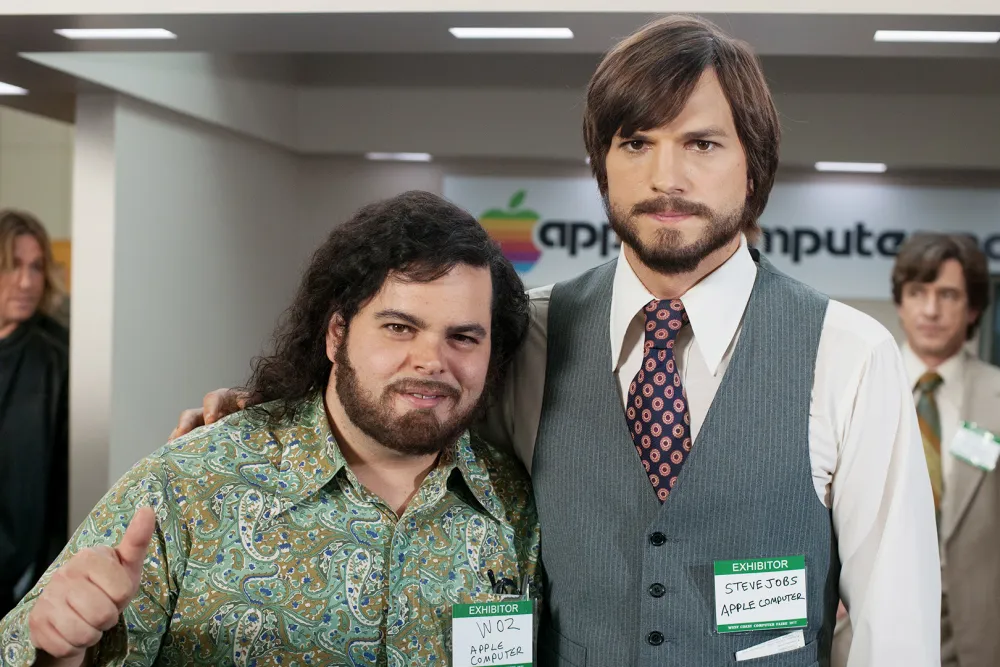
Steve Jobs, Steve Wozniak, and the Price of Changing the World
There is a moment late in Jobs, the 2013 film starring Ashton Kutcher as Steve Jobs, that quietly asks a question far bigger than Apple.
What does it cost to build something extraordinary?
Not in dollars. Not in sleepless nights. Not even in professional sacrifice.
What does it cost in people?
By the time Steve Wozniak approaches Jobs and tells him that he is leaving Apple, the two men standing before each other barely resemble the two young friends who once built computers together. Apple has grown. Steve Jobs has grown with it or perhaps hardened with it. And somewhere between the garage, the investors, the deadlines, the Macintosh and the relentless pursuit of perfection, something else has disappeared.
Their friendship.
And perhaps the most painful part is that neither man is necessarily wrong.
Two Friends, Two Different Ideas of Success
In the beginning, Jobs and Wozniak seem almost perfectly suited to one another.
Wozniak is the technical genius. He loves computers because computers are fascinating. There is a playfulness to his brilliance. Building something is exciting because building it is exciting.
Jobs sees something different.
He doesn’t simply see a computer.
He sees what the computer could become.
That distinction drives much of Jobs. Again and again, the film portrays Jobs as the person in the room who refuses to accept the limitations everyone else has already accepted.
When something is good, he wants it better.
When someone says something cannot be done, he wants to know why.
When employees fail to meet his expectations, sympathy is rarely his first response.
To the people around him, this can make him arrogant, cruel and almost impossible to work with.
But the uncomfortable question the movie raises is this:
What if that is also part of the reason Apple became Apple?
The Man Who Could Not Leave “Good Enough” Alone
Throughout Jobs, we watch Steve become increasingly consumed by his vision.
The relaxed atmosphere of the early computer hobbyist world gradually gives way to deadlines, product launches, corporate politics and enormous expectations.
Jobs doesn’t appear interested in merely running a successful company. He wants to create products that change people’s relationship with technology.
And people who think like that can be exhausting.
There is always another detail.
Another flaw.
Another improvement.
Another person who isn’t moving fast enough.
Jobs’ intensity creates casualties. Employees feel disposable. Relationships become strained. His personal life suffers. Even the people who believed in him sometimes find themselves on the receiving end of his anger.
From a normal human perspective, it is easy to watch some of these scenes and think:
Steve, relax.
But then comes the difficult second thought.
Would Apple have become Apple if Steve Jobs had relaxed?
That doesn’t excuse cruelty. Ambition should never become a blank check for mistreating people.
But it does complicate the story.
Wozniak Wanted Something Different
Steve Wozniak represents an entirely different philosophy.
He loves technology, but he doesn’t appear to need domination.
He doesn’t need every room to bend toward his vision.
He values the people who helped build the company. He remembers the friendships, the engineers and the experience of creating something together.
And this difference between the two Steves becomes increasingly important.
Jobs seems to ask:
How great can we make this?
Wozniak seems to ask:
Can we still enjoy what we’re doing and remember the people doing it with us?
Those questions aren’t enemies.
In a perfect world, they would complement one another.
But ambition has a strange ability to turn priorities into competitors.
Time spent protecting a friendship can feel like time taken away from the mission. Compromise can begin to feel like weakness. Nostalgia can look like resistance to progress.
Eventually, two people who started by looking in the same direction can discover that they are no longer walking toward the same destination.
“We Don’t Even Talk Anymore”
That is what makes the later conversation between Wozniak and Jobs so powerful.
Wozniak isn’t simply telling Steve that he wants another job.
He is mourning something.
These were friends.
They built something together that almost nobody around them could have imagined becoming what it became. They were there before the executives, before the enormous valuations, before Apple became a cultural institution.
And now Wozniak is essentially standing in front of his old friend saying: I don’t know you anymore.
The painful emphasis that they barely even talk anymore says almost everything.
Think about that.
You can build a company with someone.
You can make history with someone.
You can become wealthy with someone.
You can help change the world with someone.
And still lose them.
Perhaps that is one of the most interesting ideas hiding underneath Jobs. Success does not automatically preserve the relationships that helped create it.
Sometimes success puts those relationships under pressures they were never designed to survive.
Does Friendship Hurt Business or Does Business Hurt Friendship?
We often hear the warning:
Never go into business with friends.
The assumption is that friendship makes people too emotional. You hesitate to fire someone. You tolerate poor performance. You make decisions based on loyalty instead of competence.
There is truth in that.
But Jobs presents the opposite danger too.
What happens when business becomes so important that friendship becomes irrelevant?
If every relationship is measured by productivity, usefulness and contribution to the mission, eventually the people closest to you may begin to feel like employees even when they aren’t.
So perhaps the problem isn’t friendship in business.
The problem is failing to understand that friendship and business operate under different rules.
Business sometimes requires uncomfortable decisions.
Friendship sometimes requires patience.
Business asks, What does the company need?
Friendship asks, How are you doing?
A mature person has to know which question the moment requires.
Jobs, at least as portrayed in the film, often seems incapable of switching modes.
Everything becomes the mission.
But Then We Have to Look at the iPhone in Our Hands
This is where judging someone like Steve Jobs becomes complicated.
It is easy to condemn obsessive personalities after enjoying the things their obsession produced.
The modern technology industry was profoundly influenced by Jobs’ insistence that computers should not merely function they should feel intuitive, elegant and personal.
Apple didn’t invent every technology it popularized. That isn’t the point.
Jobs had an extraordinary ability to recognize where technology could go and then relentlessly push people toward that destination.
That relentless personality came with a price.
But society received something from it too.
This pattern appears throughout human history. Some extraordinary creators, entrepreneurs, artists and leaders have been extremely difficult people.
That does not mean greatness requires cruelty.
It means greatness often requires an unusual level of obsession and obsession, when uncontrolled, can consume things that were never intended to be sacrificed.
Including friendships.
Maybe Jobs Needed Wozniak More Than He Realized
Perhaps the tragedy isn’t that Jobs was too ambitious or that Wozniak wasn’t ambitious enough.
Perhaps they represented two things that human beings need simultaneously.
Jobs represented purpose.
Wozniak represented perspective.
Jobs looked toward what could exist tomorrow.
Wozniak remembered the people standing in the room today.
One pushes civilization forward.
The other reminds us why moving forward matters.
Maybe the mistake is believing we have to choose between them.
Because what is the point of building something that connects millions of people if, somewhere along the way, you become disconnected from the people who knew you before anyone knew your name?
And yet, what happens if you protect every relationship, avoid every uncomfortable decision and compromise every ambitious idea simply to keep everyone happy?
Perhaps nothing extraordinary gets built.
That is the uncomfortable balance Jobs leaves us with.
The Price of the Dream
Steve Jobs wanted to change the world.
Steve Wozniak wanted to build wonderful things and still recognize the people beside him.
History needed both of them.
And maybe that is why their story remains fascinating.
The lesson isn’t that we should become Steve Jobs.
And it isn’t that we should reject his intensity and simply become Wozniak.
The lesson may be to recognize the danger at both extremes.
Dream too little, and we may never discover what we are capable of creating.
Dream so obsessively that everything else becomes expendable, and one day we may finally reach the mountain we were determined to climb only to discover that nobody we loved made the journey with us.
Maybe the real measure of success isn’t simply whether we changed the world.
Maybe it is whether, after changing it, the people who helped us get there can still call us a friend.
